Body-Contouring Equipment: Treatments, Machines and the Business Case for Your Practice
Body-contouring equipment can help a practice address selected concerns about localized fat, muscle definition or skin appearance. Those are different treatment goals, with different patient expectations, staffing requirements and economics. A machine that creates interest at a demonstration can still become an expensive commitment if the patients, room time and follow-up needed to support it are missing.
This guide explains the main equipment categories, compares several established platforms and works through the costs of a realistically imperfect month. It is written for owners choosing a first device, adding a service or reconsidering equipment they already own.
Build and save my business case ↗Body-contouring equipment at a glance
What concern will we address?
Localized fat, muscle conditioning, skin laxity and cellulite require different discussions. One appealing before-and-after image does not establish that a platform covers all four.
Which machine deserves a demo?
Choose the treatment purpose first. Then compare the exact applicators, clinical requirements, full appointment time and recurring costs.
Can the practice afford it?
Model collected revenue and completed appointments, including a slower-booking month. The equipment payment continues when appointments do not.
What should make us wait?
Unproven demand, unresolved clinical suitability, inadequate cash reserves or a service that depends on consistently filling spare capacity from day one.
By NuWays MD · Professional planning guide · Sources and calculations checked September 22, 2026
What do body-contouring treatments actually do?
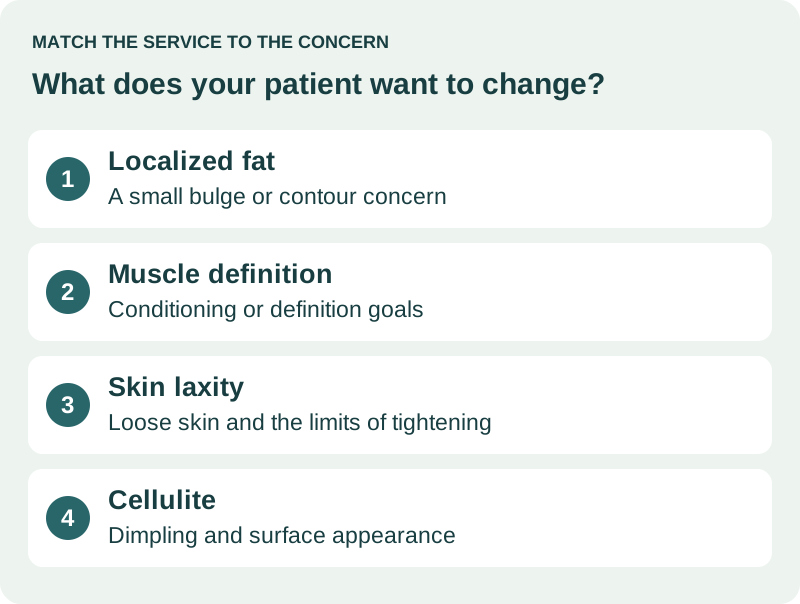
The first question is what patients mean when they say they want to “tone up.” Some are concerned about a small fat bulge. Others mean less loose skin, a more defined abdomen or reduced dimpling. Your consultation and marketing need to make those differences understandable before a package is sold.
| Patient’s concern | Treatment category worth discussing | What an owner should understand |
|---|---|---|
| A localized fat bulge | Selected cooling, radiofrequency, laser or ultrasound approaches | These are contouring services, not a substitute for weight management. The proposed area and patient need must match the device’s authorized use. |
| Muscle conditioning or definition | Magnetic or electrical muscle stimulation, depending on the system | The mechanism and indicated use vary. Strong contractions, a change in a study measurement and a visible transformation are not interchangeable outcomes. |
| Mild skin laxity | Selected energy-based tightening approaches | More substantial excess skin may lead to a surgical discussion. A new device cannot make every post-weight-loss concern suitable for a nonsurgical package. |
| Cellulite or surface dimpling | Technologies specifically intended for the relevant appearance concern | Cellulite involves more than fat volume. A fat-reduction result does not automatically demonstrate improvement in dimpling. |
The FDA describes noninvasive contouring as changing selected body contours without surgically removing tissue. It is not an obesity treatment. Risks vary with the technology and include burns, pain, swelling or altered sensation. Cooling-based fat reduction has the additional risk of paradoxical adipose hyperplasia, or PAH, in which treated fat enlarges; it may require surgery. These distinctions belong in clinical screening and informed consent, not just the purchase file. FDA overview
For a patient with significant excess skin or a larger desired contour change, your clinical team may recommend a surgical consultation. The American Society of Plastic Surgeons explains the difference between nonsurgical fat reduction and liposuction. A plastic-surgery practice may use nonsurgical options within a broader service offering; a solo startup needs a clear referral boundary when a patient’s needs fall outside its services.
Which body-contouring machines are worth comparing?
The table below compares treatment approaches rather than declaring one machine best. Manufacturer pages establish how companies describe their platforms, not independent proof that one option produces better outcomes or greater profit. Configuration, availability, training and authorized uses need to be checked for the market where you practice.
| Platform | Technology described by its manufacturer | Why it may deserve consideration | What to establish before buying |
|---|---|---|---|
| CoolSculpting Elite | Controlled cooling for localized fat reduction | A practice with suitable demand for fat-reduction consultations and a clinical team prepared to discuss its distinctive risks | Applicators in the quote, treatment-cycle definitions, consumable commitments, area planning, PAH consent and service support |
| EMSCULPT NEO | High-intensity focused electromagnetic energy, or HIFEM, combined with synchronized RF heating | A practice investigating muscle conditioning and fat-related indications within the platform’s authorized uses | Applicator and protocol scope, contraindication screening, monitoring, complete appointment time and how the proposed service fits current demand |
| InMode EvolveX | Tite uses bipolar RF; Tone uses electrical muscle stimulation; Transform combines RF and EMS | A practice considering several noninvasive body-treatment functions within one platform | Which applicators and functions are included, how many can be used in your proposed workflow and the actual staffing and monitoring plan |
| Cutera truSculpt | Monopolar RF for noninvasive fat-reduction applications | A practice comparing a heat-based fat treatment with cooling or other approaches | Quoted configuration, supplies, patient selection, placement and monitoring requirements, service coverage and treatment-area economics |
| Cutera truFlex | Electrical muscle stimulation using the manufacturer’s multidirectional stimulation approach | A practice specifically investigating muscle-stimulation services | Intended use, protocols, staffing, patient tolerability and whether demand supports a separate muscle-focused purchase |
Manufacturer sources, checked September 22, 2026: CoolSculpting Elite, EMSCULPT NEO, EvolveX, truSculpt and truFlex. These examples are not an exhaustive market list. A comparable public new-equipment price was not established for these configurations, so this guide does not supply invented purchase-price ranges.
Explore the equipment catalog for the existing device records, or compare the three body platforms currently in that catalog. The record comparison helps organize configuration questions; it does not establish equivalent treatment results.
Why similar sales descriptions can hide important differences
“Muscle stimulation” can refer to magnetic or electrical energy. “RF” tells you radiofrequency energy is involved, but not the same depth, applicator or treatment experience across platforms. “Hands-free” usually describes how applicators deliver treatment after placement; it does not establish permission to leave a patient unsupervised or double-book the treating clinician.
The term truBody can describe the combination of truSculpt and truFlex services. It should not lead you to assume a quote includes both systems. Similarly, a platform capable of several functions may be offered with only some applicators. Compare what the proposal actually supplies.
Morpheus8 body treatments belong to a different operating discussion because RF microneedling penetrates the skin and brings different clinical, comfort and recovery considerations. If that is your intended service, use the RF equipment buying guide alongside this one.
How strong is the evidence, and what should you ask about it?
Look for the endpoint a study measured, the people included, the comparison group and the follow-up period. A percentage reduction in the thickness of a selected fat layer is not the same as a percentage reduction in body fat or body weight. Measurements from one device study cannot be placed beside an unrelated trial as though they were a head-to-head comparison.
One randomized sham-controlled study of synchronized RF and HIFEM included 72 participants and assessed abdominal fat and muscle thickness with ultrasound after three weekly treatments. Follow-up extended to six months. That design is more informative than a small uncontrolled before-and-after gallery, but it still does not establish your patients’ outcomes, results in every body area or the profitability of buying a machine. Samuels and colleagues, 2022
| Material in the sales presentation | What it can help establish | What it leaves unanswered |
|---|---|---|
| Authorized labeling and instructions | Intended uses, warnings and operating requirements for the specified device | Whether the purchase is financially suitable for your practice |
| A controlled clinical study | Results for a defined population, protocol and measurement | Whether a different patient, setting or body area will respond similarly |
| Before-and-after photographs | The kind of visible change being presented | Typical response, nonresponders, consistency of pose and lighting, other treatments and durability |
| Satisfaction survey | How respondents described their experience | Objective change, the experience of nonrespondents and comparative effectiveness |
| Revenue case study | A particular practice’s reported business experience | Your acquisition costs, staffing, patient mix, local competition or future bookings |
For safety, use the current device information and a clinically appropriate consent process. For example, a published multicenter cryolipolysis cohort examined PAH across thousands of cycles and different equipment generations. That is useful context, but its observed rate is not automatically an individual patient’s risk with a current Elite treatment plan. Check the denominator, generation and ascertainment method whenever a precise risk number appears. Nikolis and Enright cohort
NuWays MD is an education and referral resource, not a medical provider. Clinical review of this guide remains outstanding. Clinical suitability, protocols, staffing and consent should be established by appropriately qualified professionals before a practice offers treatment.
How much can a body-contouring service contribute each month?
Start with what the practice collects for a completed appointment. Subtract the supplies and additional labor needed to deliver it. The amount left is contribution: money available to cover the equipment commitment, marketing and the rest of the business.
Here is a fictional monthly example, not a recommended fee or a market benchmark:
| Monthly assumption | Amount or calculation |
|---|---|
| Booked visits | 30 |
| Completion rate | 80%, producing 24 completed visits |
| Revenue allocated to each completed visit | $500 |
| Supplies per completed visit | $110 |
| Incremental treatment labor per completed visit | $60 |
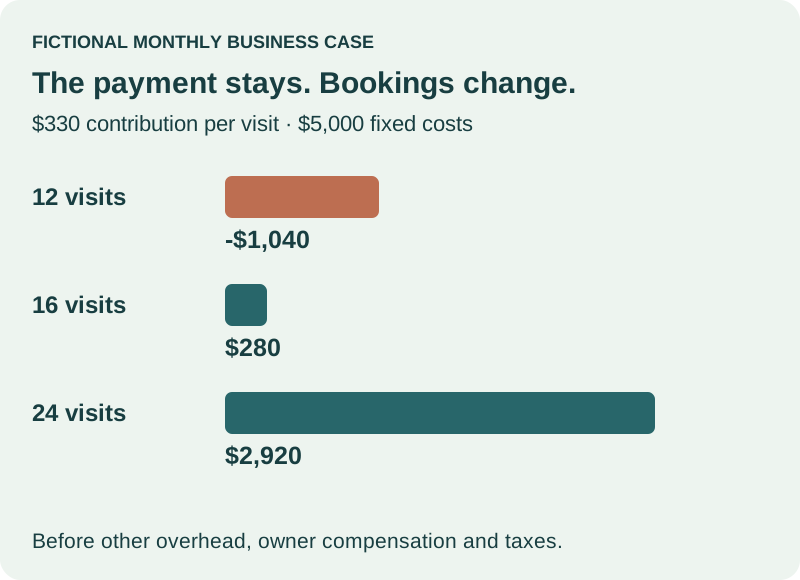
| Contribution per completed visit | $500 − $110 − $60 = $330 |
| Equipment payment | $2,800 |
| Service allowance | $300 |
| Marketing | $1,500 |
| Other fixed service costs | $400 |
| Total monthly fixed commitments in this example | $5,000 |
| Contribution after those commitments at 24 visits | 24 × $330 − $5,000 = $2,920 |
| Contribution after those commitments at 12 visits | 12 × $330 − $5,000 = −$1,040 |
The service needs 16 completed visits to cover this defined $5,000 commitment: $5,000 ÷ $330 = 15.15, rounded up. That is not the entire practice’s profit target. Rent, other payroll, owner compensation, tax and any omitted costs still need to be funded.
A salaried team creates a second useful view. Existing payroll may not increase immediately when one more appointment is added, but the service still consumes staff capacity. Keep a cash-contribution view and a fully allocated view, rather than quietly treating salaried labor as permanently free. Do not count the same wage in both variable treatment costs and fixed payroll.
Your body-contouring business case
Use the example to understand the calculation, then start with your own figures. All money is in US dollars.
Calculate to see the breakdown.
Keep the figures and the next steps together
Save this editable worksheet, track the five preparation steps and download a copy. Return through your private practice workspace. No email delivery, marketing enrollment or vendor introduction is included.
Why selling a package does not finish the cash-flow story
Suppose four people each buy three visits for $1,500. The practice collects $6,000, but has promised 12 appointments. After each person attends once, eight visits remain. At $170 of treatment delivery costs per visit, those outstanding visits will require another $1,360, plus appointment capacity and the continuing fixed commitments.
This is a planning example, not an accounting rule for recognizing revenue. Its purpose is to prevent prepaid cash from being mistaken for cash that is entirely available to spend. Keep a package-balance report that identifies visits delivered, visits owed, refunds and expiry terms. Your software evaluation should test this exact workflow.
If a treatment series needs repeated appointments, work out how new package sales and existing package visits share the same calendar. A launch can look strong on sales while creating a crowded follow-up schedule and less room for new revenue later.
How many leads would the service need?
Work backward through your own funnel. A fictional month with 80 qualified inquiries, a 40% consultation-booking rate, a 75% consultation-attendance rate and a 50% purchase rate produces 12 new purchasers. If each buys three visits, that creates 36 treatment obligations over the course, not necessarily 36 completed visits in that month.
Measure marketing cost against purchasers and collected revenue as well as inquiries. An inexpensive lead can be costly if the person is unsuitable, outside your area, unable to attend or seeking a result you cannot reasonably offer. Keep clinical suitability separate from sales conversion so staff are not rewarded for pushing inappropriate treatment.
Brand recognition can help people understand what you offer. It also brings comparison shopping. A recognizable device name does not make your follow-up, consultation quality, scheduling or local competition disappear.
Lessons from owning a practice and paying for equipment
NuWays MD’s founder operated an aesthetic practice for approximately seven years. His historical experience with CoolSculpting was financially disappointing: the purchase commitment, recurring treatment credits and marketing made the service harder to support than expected. He also encountered poor resale prospects when trying to move on. Those are his account of that purchase, not a current valuation of CoolSculpting Elite or a verified statement about every dealer’s market.
His experience with InMode EmpowerRF was more positive, including responsive support and several treatment functions that served existing patient needs. That experience does not establish EvolveX performance; the practice’s platform was EmpowerRF. The useful common lesson is that the value of a machine depends partly on the team and demand already available to use it.
The buying mistake he would avoid: adding multiple equipment payments before the first new service has dependable demand. Each device adds training, marketing, supplies and delivery time. A practice can be busy overall while a particular machine remains underused. Read the ownership-cost guide for more of that operational perspective.
What should a body-contouring demonstration prove?
Bring your clinical lead and the person who will manage the appointments. Time the complete workflow, not just the energy-delivery portion: screening, photographs, preparation, placement, treatment, removal, documentation, checkout and room turnover. Clinical requirements set the boundaries for any scheduling assumptions.
- Patient fit: which of your actual consultation requests match the authorized service, and which should be declined or referred?
- Practical delivery: who performs each step, who monitors the patient and what happens if assistance is needed?
- Consumables: what is used for a complete appointment, including multiple areas or applicators, and what is wasted if treatment stops?
- Results discussion: how are realistic improvement, nonresponse, maintenance and alternatives explained?
- Follow-up: who handles a concern, an unhappy patient or a complication, and how is escalation documented?
- Continuity: what happens when a staff member leaves, an applicator fails or supplies arrive late?
Ask for the same configuration and service terms in every proposal. Use the equipment quote comparison to document what is included and what remains unresolved.
When should a practice wait instead of buying?
Waiting is a useful option when the business case requires demand that has not yet appeared. Start by reviewing the last few months of relevant consultation requests, existing patients who asked about the service, declined treatment reasons and unused room time. Use de-identified counts, not patient information in a general planning worksheet.
For a solo startup, the cash reserve and the time needed to market, consult and deliver treatment may be more limiting than the machine’s capacity. For an established team, a bottleneck may be a room or trained staff member. For plastic-surgery and dermatology practices, consider whether the service supports the existing care pathway or creates an unrelated operational burden.
A useful pre-purchase milestone is written evidence that you have clinically suitable demand, a workable staffing plan, affordable slower-booking months and a proposal with the expensive unknowns resolved. A representative’s launch forecast can help generate questions; it should not substitute for that evidence.
Save my body-contouring business case
Keep your own figures, preparation progress and open questions in one private practice worksheet.
Open my worksheet and save ↗Frequently asked questions
Which body-contouring machine is best for a new med spa?
There is no universal first purchase. Start with the services your qualified team can provide and the concerns your likely patients actually bring. If the business case depends on immediately filling a large new calendar, delaying the equipment commitment may be more useful than choosing a lower payment.
Does hands-free treatment mean I can treat someone else at the same time?
Do not assume it. Determine monitoring, supervision, emergency response, staff competency and scope requirements for the exact device and setting. Only then assess what other work can safely occur during the appointment.
Should I advertise fat reduction and weight loss together?
Make the distinction clear. Noninvasive body contouring addresses selected localized concerns and is not an obesity treatment. Patients seeking significant weight change or substantial excess-skin correction need an appropriate clinical discussion rather than a broad promise from a device advertisement.
Is a device with several functions better value?
It can be if the included functions meet real demand and your team can deliver them well. Unused capabilities do not repay the purchase price. Evaluate each planned service’s supplies, staffing and calendar demands before adding their projected revenue together.
Can I rely on resale value to limit my risk?
Treat it as an uncertain secondary scenario. Obtain current, comparable dealer offers and check transfer, service and transport costs. An advertised used-machine price is not a guaranteed exit value.
Should I offer a large launch discount?
Calculate the discounted contribution per visit and the appointments the offer commits you to deliver. A package that fills the schedule but leaves too little money for supplies, staffing and fixed costs can deepen the problem. Expiry and refund terms should be clear before purchase.
Sources, experience and commercial disclosure
Sources were checked September 22, 2026. Clinical background comes from the FDA and ASPS, the study examples from the linked publications, and platform descriptions from the linked manufacturers. We have not independently tested these machines or verified vendor earnings claims. The financial examples are original fictional models, not typical practice results or vendor quotes.
There are no active equipment referral agreements represented here. Saving a plan does not authorize sharing it with a vendor. Any future introduction should identify the recipient and compensation relationship before separate permission is requested. See how NuWays MD uses evidence and commercial relationships.