What will the machine cost when the calendar is quiet?
Work beyond the purchase price. Separate fixed commitments from treatment costs, use collected package revenue and test the service at a slower pace.
Build my equipment plan ↗The practical answer
A device is not affordable merely because a typical treatment price is higher than its disposable tip cost. The business needs enough completed, collected treatments to cover recurring commitments, while leaving room for training, downtime, refunds and the owner’s cash needs.
Start with three questions: what cash is committed each month, what remains from one delivered treatment, and whether documented demand plus staffed capacity can support the required volume. A practice with strong demand but no available provider time has a different constraint from one with an empty room and few inquiries.
Build the model in the right order
| Step | Use this input | Avoid this shortcut |
|---|---|---|
| 1. Monthly commitments | Payment, service allocation, incremental marketing and other fixed obligations. | Dividing purchase price by an optimistic number of treatments. |
| 2. Collected revenue per delivered visit | Package revenue allocated across sessions, adjusted for discounts and refunds. | Using the highest menu price for every treatment. |
| 3. Variable cost per visit | Tips, other supplies, paid provider time and applicable processing costs. | Treating the tip as the entire cost of delivery. |
| 4. Available treatment capacity | The overlap of room and qualified provider availability, including turnover. | Assuming every open room hour is a bookable treatment hour. |
| 5. Demand and ramp-up | Observed inquiries, conversion evidence and a slower-start case. | Assuming all brand-name leads become paying patients. |
A worked example you can check
| Fictional monthly fixed cost | Amount |
|---|---|
| Equipment payment | $2,500 |
| Service reserve or allocation | $300 |
| Incremental marketing | $1,500 |
| Other incremental fixed costs | $500 |
| Total modeled fixed commitments | $4,800 |
| Per completed treatment | Amount |
|---|---|
| Collected revenue allocated from package | $700 |
| Disposable tip | $85 |
| Other supplies and comfort measures | $45 |
| Incremental labor allowance | $90 |
| Processing allowance | $15 |
| Contribution before fixed commitments | $465 |
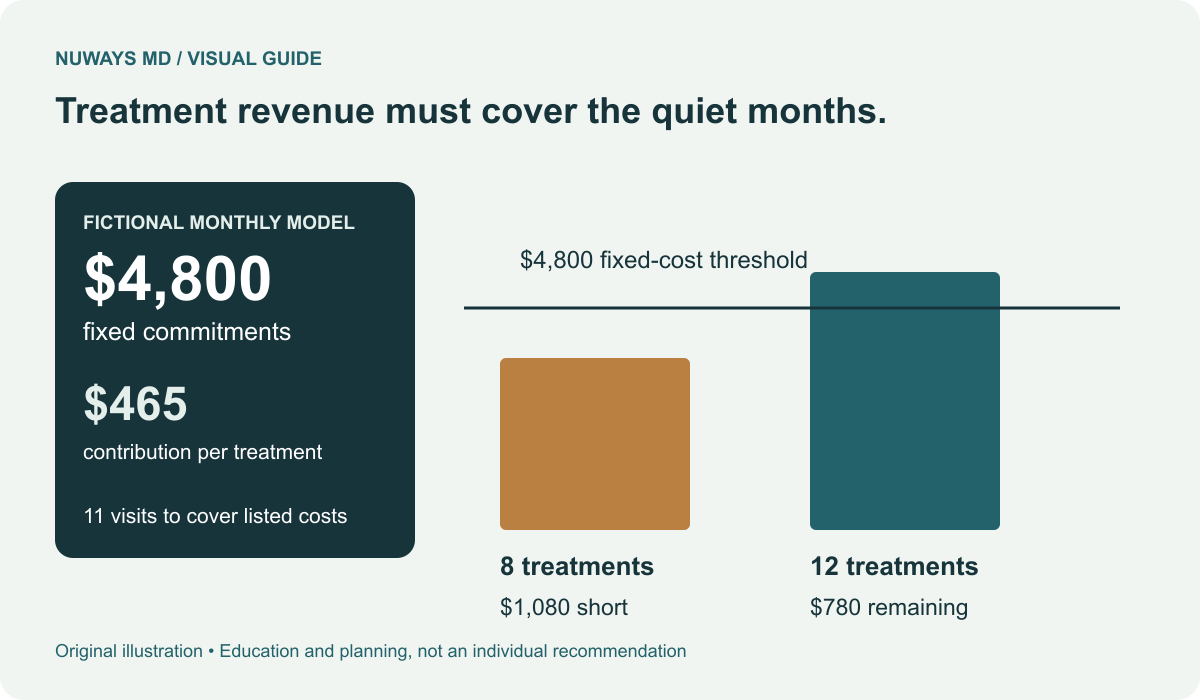
At these assumptions, $4,800 ÷ $465 = 10.32. The service needs 11 completed treatments in a month to cover the modeled fixed costs. At eight treatments it is $1,080 short. At twelve it leaves $780 before excluded costs. That narrow remainder can disappear with cancellations, extra marketing or an unplanned repair.
This is cash-coverage arithmetic for the listed service costs, not accounting profit or a recommendation to finance equipment. It excludes tax, practice-wide overhead, owner compensation outside the labor allowance, unplanned care and additional capital spending. Those omissions can materially change the decision.
The package trap: cash received is not all earned today
If a patient pays $2,400 for three sessions, use $800 per delivered session before any adjustments. The remaining visits still require labor, room time and supplies. A busy sales month can therefore be followed by a busy treatment month with less new cash coming in.
Track sales and delivery separately
Record package cash collected, visits owed, visits completed and any refunds. Otherwise a strong sales month can hide future delivery commitments.
Do not double-count provider cost
If scheduled payroll is already included as fixed cost, do not add the same payroll again as variable labor. If treatment work adds paid hours or displaces other revenue, reflect that consistently.
When waiting or buying less may make sense
Low confidence in demand
Write down what you know about demand and what would need to be true for the payment to work. A smaller service menu or delayed purchase may be better than signing a contract while the demand evidence is still a guess.
Existing device still meets the need
Compare keeping it with the incremental revenue and cost of replacement. New capabilities are useful only if the practice can support and use them.
Used equipment looks inexpensive
Obtain written confirmation of transfer eligibility, service availability, software access, required inspections and genuine consumables. A low asking price alone does not establish an operable purchase.
A second device competes for the same people
Model both schedules together. If the same clinician, room or marketing budget is required, adding the second device may divide existing capacity instead of increasing it.
Put promises into a quote you can retain
Ask the supplier to separate what is included at delivery from recurring charges and optional upgrades. Record training, service exclusions, response procedures, supply pricing, software obligations and end-of-term or resale conditions. Keep dated copies in the decision file.
If a rep describes special pricing, guaranteed support, exclusivity or a trade-in benefit, the written agreement should identify the actual terms. A helpful relationship is valuable, but it does not replace a contract that another person can enforce or understand.
See the fictional side-by-side quote example ↗A lesson from seven years of ownership
The founder recalls positive experience with EmpowerRF and InMode support, alongside the difficulty of carrying multiple equipment commitments. Lease payments, marketing, supplies, numbing and treatment time accumulated whether or not bookings met expectations.
The lesson informing this guide is to establish one service’s demand and operating rhythm before adding the next commitment. It is one owner’s experience, not a universal purchasing rule or a claim about a vendor’s clinical outcomes.
See the actual recalled Morpheus8 package examples ↗Use your numbers. Keep the reasoning.
Start with a quote or your current service idea. Save the assumptions, compare written offers and reopen a slower-demand ROI scenario before committing.
Compare my equipment costs ↗Sources and how we used them
Sources checked September 15, 2026. All monetary figures in this guide’s worked model are invented, and calculations are shown for inspection. No market-price survey, financial forecast or clinical assessment is implied. NuWays MD has no active equipment referral agreements; saving a report does not grant vendor sharing permission.
- NuWays fictional quote comparison: a second worked example showing how service and supply terms change ownership cost.
- Founder’s operating examples: historical recollections supplied by the owner, with limitations.