How to Compare Aesthetic Equipment Quotes: Price, Financing, Service and Supplies
A lower equipment price does not always mean a lower cost to your practice. One offer may include the handpieces you need, first-year service and staff training. Another may leave those items for you to purchase later. Financing can make the monthly payment manageable while extending the commitment well beyond the period you are comparing.
This guide shows you how to read a proposal, put two offers on the same basis and understand what slower bookings would do to the decision. The worked quotes are fictional. Use their structure with your own written proposals, then save the figures and unanswered questions in your practice workspace.
Build and save my quote comparison ↗Equipment quotes at a glance
Which offer is cheaper?
Compare the same equipment configuration, ownership period and number of completed treatments. Then include service, required supplies and delivery costs.
Does a low payment mean a good deal?
It tells you one cash-flow obligation. You also need the deposit, number of payments, end-of-term amount and any fees.
How much will I earn?
Start with collected revenue per completed visit, subtract treatment delivery costs, then cover the recurring commitments. An equipment quote cannot establish demand.
What if I am still unsure?
Keep missing costs visible. A blank service allowance should remain an unanswered question, not quietly become zero.
By NuWays MD · Professional planning guide · Sources and calculations checked September 22, 2026
What should an aesthetic equipment quote include?
A useful quote lets you identify exactly what arrives, what the practice must supply and which obligations continue after delivery. Ask for the full proposal and the documents it incorporates, including service terms and any separate financing agreement. A helpful sales explanation is worth recording, but important promises need to appear in the agreement you will rely on.
Think about your first ordinary treatment day. The device has arrived, a staff member has called out, the patient bought a package, and a disposable is missing. The proposal should help you understand which of those problems the vendor can solve and which remain yours.
An annotated proposal: eight places to look
| Proposal line | What it should make clear | Why it changes the decision |
|---|---|---|
| 1. Console and configuration | Exact model, generation, condition, serial number when available, software features and authorized seller | A familiar brand name can cover different generations and capabilities. A discount on a configuration you cannot use is not a saving. |
| 2. Handpieces and accessories | Named applicators, sizes, quantities, cables, footswitches and included replacements | A demonstration may use accessories that are absent from your quote. Identify everything needed for the services you intend to offer. |
| 3. Treatment supplies | Starter quantity, unit definition, replenishment price, minimum order, shipping, expiry and any use limits | A “treatment” credit, tip, cycle, pulse allowance and patient appointment can be different things. Your cost model needs the quantity used per delivered appointment. |
| 4. Delivery and installation | Freight, insurance, setup, required electrical or room work, acceptance testing and who fixes delivery damage | Installation can create a separate expense and delay revenue. Confirm what must be ready before a technician arrives. |
| 5. Training | Which roles attend, number of people, format, travel, competency expectations and later staff training | One launch-day demonstration does not necessarily cover turnover, advanced applications or clinical supervision. |
| 6. Warranty and service | Start date, duration, covered parts, handpiece limits, labor, travel, shipping, exclusions and renewal terms | “Service included” can mean very different coverage. A response-time promise is not a repair-time promise. |
| 7. Payment and financing | Deposit, balance due, payment schedule, fees, deferred-payment terms, end-of-term obligations and guarantee requirements | Financing may be a separate contract with a separate company. The equipment’s performance does not automatically suspend those payments. |
| 8. Cancellation, transfer and downtime | Return rights, cancellation charges, transfer restrictions, software access, loaner policy and responsibility during repairs | A device that cannot be transferred economically may have less resale flexibility than you expect. A loaner is only useful if its availability and terms are clear. |
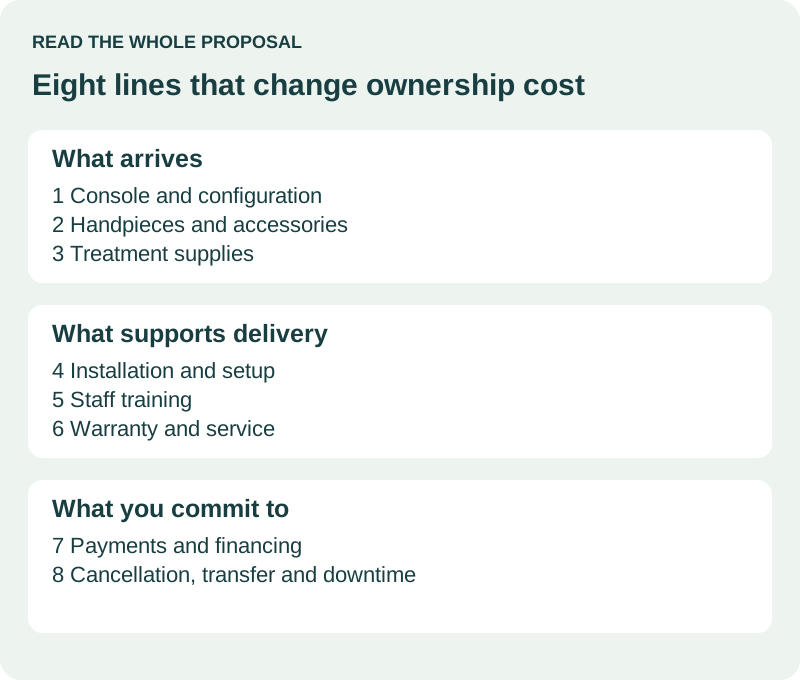
A practical annotation method: mark each line included, priced separately, excluded or not answered. Keep the rep’s answer beside the relevant clause. This makes the next conversation specific: “Does this annual service price cover the body handpiece and technician travel?” is much easier to resolve than “Is everything covered?”
How do you compare two equipment quotes fairly?
Use the same planning period and completed treatment volume for both. Count collected revenue rather than the menu price, and include the supplies actually consumed by your protocol. Keep both the equipment purchase and the delivery of treatments visible, even when some costs are identical between offers.
Here is a fictional cash-purchase comparison, in US dollars, over three years. It is an arithmetic example, not a market-price estimate or a comparison of named brands. Both offers are assumed clinically suitable for the same service and able to support the same workload.
| Comparable item | Offer A | Offer B |
|---|---|---|
| Equipment purchase | $80,000 | $90,000 |
| Delivery and setup | $4,000 | $4,000 |
| Annual service allowance | $5,000 | $2,000 |
| Supplies per completed treatment | $95 | $75 |
| Completed treatments per month | 24 | 24 |
| Completed treatments over 36 months | 864 | 864 |
| Collected revenue allocated to each treatment | $650 | $650 |
| Other variable treatment costs, including labor | $115 | $115 |
The narrower equipment-and-supplies subtotal is purchase + setup + three years of service + supplies for 864 treatments:
- Offer A: $80,000 + $4,000 + $15,000 + $82,080 = $181,080.
- Offer B: $90,000 + $4,000 + $6,000 + $64,800 = $164,800.
- Offer B costs $16,280 less within this defined comparison despite its $10,000 higher purchase price.
Adding the identical $115 of other variable costs for each of 864 treatments adds $99,360 to both. The resulting modeled cash costs are $280,440 for A and $264,160 for B. Neither total includes the practice’s rent, general marketing, owner pay, taxes or other costs you have not entered. Calling the difference “profit” would skip those obligations.
What changes when bookings are slower?
At six completed treatments per month, the three-year equipment-and-supplies subtotals become $119,520 for A and $116,200 for B. B’s advantage shrinks to $3,320. The lower supply cost has fewer appointments over which to repay the higher purchase price.
The service assumption also matters. If both offers actually cost $2,000 a year to service, A becomes $5,680 cheaper at six treatments a month. At 24 treatments a month, B remains $7,280 cheaper. With equal setup and service costs, B’s extra $10,000 is recovered after 500 completed treatments, because its supply saving is $20 per treatment: $10,000 ÷ $20 = 500.
That is why “How many treatments pays for it?” needs more than the purchase price divided by your fee. It needs a contribution margin, a realistic workload and a complete list of recurring commitments. The equipment ownership guide develops those costs further.
Compare your own two offers
Enter the same time horizon and expected completed treatments for each offer. The tool starts with the fictional cash-purchase example above. Replace every assumption you can, and mark missing figures before treating the result as a purchasing decision.
Your two-offer equipment comparison
Use the example to understand the calculation, then start with your own figures. All money is in US dollars.
Calculate to see the breakdown.
Keep the figures and the next steps together
Save this editable worksheet, track the five preparation steps and download a copy. Return through your private practice workspace. No email delivery, marketing enrollment or vendor introduction is included.
A saved comparison keeps the figures, your open questions and the next step together. Saving does not request a vendor introduction or send your proposal to an equipment company. There are no active equipment referral agreements represented by this guide.
How should financing change the comparison?
Financing changes when cash leaves the practice. It does not remove the commitment. Read the equipment agreement and financing documents together, especially if one company sells the machine and another collects payments. The SBA’s equipment-financing checklist provides a general starting framework; your own signed terms control your obligations.
Consider a separate fictional financing example: an $8,000 initial payment followed by 60 payments of $1,750. Scheduled cash outflow is $113,000 before service, supplies or any additional fees. After 36 payments, the practice has paid $71,000 and still has $42,000 of scheduled payments remaining. A three-year view that displays only $71,000 hides a substantial commitment.
The comparison tool lets you select cash purchase or scheduled financing for each offer. For financing, it shows payments within your selected period and those left afterward. It does not calculate an APR, account for early payoff discounts or establish the legal form of the contract. Enter a required end-of-term payment separately.
Questions that make a financing conversation useful
- When does the payment obligation begin: signing, delivery, installation or acceptance?
- Does “no payments for three months” postpone the schedule, accrue charges or create a larger balance later?
- Is there a required purchase option, balloon payment or return obligation at the end?
- What is the written early-payoff amount or formula? Is it different from the sum of remaining payments?
- Who owes if the practice closes, ownership changes or the device remains out of service?
- Are personal guarantees, security interests, insurance requirements or automatic renewal terms involved?
Have your accountant and appropriate legal adviser evaluate the actual documents when those obligations are material. The key business point is to understand the full commitment before using the monthly payment in your break-even calculation.
What does “service included” really cover?
Start with the expensive parts most likely to interrupt your planned service. Ask how the agreement handles the console, handpieces, accessories, preventive maintenance, software, remote troubleshooting and onsite labor. Record any limits based on usage, age or who last serviced the device.
Then work through an ordinary failure: “If this handpiece stops working on Monday, what happens next?” Identify who answers, how diagnosis happens, who ships the part, when a technician can attend and whether a usable replacement is available. “We respond within 24 hours” may describe an acknowledgment rather than a repair.
Model the cost of downtime without inflating it
If six appointments are permanently lost and each would have produced $440 after variable treatment costs, lost contribution is $2,640. It is not the $3,900 of gross treatment revenue, because those visits would also have consumed supplies and other variable costs. If all six appointments can be moved into otherwise empty slots, that immediate loss may be smaller, although refunds, inconvenience and staff rescheduling still matter.
A crowded practice has a different problem: rebooked visits can displace future appointments. Compare the repair scenario with your actual room and provider capacity, and keep a cash reserve for payments that continue during an interruption. Do not add the same lost income and replacement-treatment expense twice.
How do packages and consumables affect the quote?
Allocate package revenue to the appointments still owed. A $2,400 package of three equally priced treatments represents $800 per treatment before any other adjustments. Collecting the money upfront does not eliminate the labor, tips or appointment time needed for the second and third visits.
For consumables, count the unit that matches your delivery plan. If one patient visit uses two applicator cycles, the cost of one cycle is not the visit’s supply cost. Include shipping, expiry, minimum purchases and supplies used during training or an interrupted treatment when they apply. Avoid dividing a promotional starter kit across every future visit as though replacements remain free.
Ask what happens if you stop offering the service while unused treatment credits or sealed stock remain. Written expiry, transfer and return terms are more useful than an assumption that everything can be resold. Body-contouring equipment economics shows how repeated supply purchases interact with slower bookings.
What is different about a used or refurbished device?
A used machine deserves two separate checks: the device’s condition and your ability to operate it with ongoing support. A working console does not by itself establish access to training, software, service or authorized consumables.
Request the exact configuration, service history, usage information available for that model, handpiece condition, warranty provider and terms, shipping protection and a written acceptance process. Confirm transfer, inspection or recertification requirements directly with the relevant manufacturer or authorized service provider. A dealer’s warranty and an original manufacturer’s warranty are not automatically the same arrangement.
Treat resale value as uncertain. Run the base case with no resale proceeds, then add a separately labeled scenario if you have current, comparable evidence. An asking price for another device is not proof of what yours will sell for after fees, transport and time on the market.
A practical decision before you sign
Put the two completed comparisons beside your demand plan. For a new solo owner, a shorter commitment or delaying the purchase may protect cash better than purchasing a more capable platform. An established team replacing a fully booked device may place greater value on service continuity and training. A dermatology or plastic-surgery practice should also evaluate how the service fits its clinical team, referral patterns and existing equipment.
Advance an offer when you can explain all four points: the configuration supports the intended service; the clinical lead accepts the operating requirements; the slower-booking case is affordable; and the contract answers the expensive uncertainties. If a key item remains unknown, request a revised proposal and keep the purchase decision open.
Save my equipment comparison and open questions
Keep your own figures, preparation progress and open questions in one private practice worksheet.
Open my worksheet and save ↗Frequently asked questions
Should I send one vendor the competing quote?
You can request a comparable configuration without sharing another company’s document. Check any confidentiality terms before forwarding a proposal. A line-by-line list of the equipment, supplies and service coverage you need often produces a more useful revision than asking the rep to beat one total.
Is free training actually valuable?
It can be, if the people who will provide and support treatments receive relevant instruction and the practice can cover later staff changes. Identify attendance, travel, timing, refresher access and clinical supervision needs. An included session that your team cannot attend has limited operational value.
Can I compare monthly payments directly?
Only after matching deposits, terms, end-of-term obligations and included costs. A lower payment over a longer period can cost more in total. Compare both cash flow during the period you are planning and payments still due afterward.
What if the representative predicts enough treatments to cover the payment?
Rebuild the estimate using your own collected fees, conversion history and variable costs. Ask whether the forecast counts inquiries, sold packages, booked visits or completed treatments. These are different stages, and a package sold today creates future work.
Should I include owner time if I do the treatments myself?
Yes, in a separate view of whether the service adequately rewards your work. An immediate cash-cost view may exclude owner compensation, but a sustainable business case should show it. Do not subtract the same pay twice if you have already included it in treatment labor or fixed payroll.
Does this guide recommend a particular vendor?
No. The examples compare contract structures and operating assumptions. NuWays MD’s founder contributes practice-ownership experience; these fictional offers are not received vendor quotes, endorsements or negotiated discounts.
Sources and how this guide was prepared
This is original operational analysis using fictional, inspectable arithmetic and the founder’s practice-ownership experience. The SBA equipment-financing checklist supports the general financing discussion. Model calculations and links were checked September 22, 2026. Published manufacturer terms, your executed agreements and professional advice take precedence over illustrative assumptions.
Continue with equipment ownership costs, body-contouring equipment or a med spa opening budget. Our editorial and commercial standards explain the limits of founder experience and how referral relationships are disclosed.