Med Spa Capacity Planning: When to Hire, Add a Room or Fix the Schedule
A full-looking calendar does not always mean your practice needs another provider or a larger space. You may have enough clinician time but too little room time. Appointments may cluster into popular hours while other sessions remain empty. Cancellations may leave gaps too late to refill, or one overworked front-desk person may be holding the entire day together.
Capacity planning means finding out which resource limits the work you can actually deliver. This guide shows you how to measure that limit, build a realistic weekly schedule and test whether a proposed expansion would bring enough additional completed visits to pay for itself.
Build and save my capacity plan ↗Capacity planning at a glance
Providers have gaps but rooms are constantly occupied
Room use, preparation, treatment time and turnover
Rooms are available but the right clinician is fully booked
Qualified provider availability, service mix and time lost to avoidable administration
Some days are full and others are quiet
Demand by day and time, scheduling rules and whether patients can use the available slots
The calendar looks full but collections disappoint
Completed visits, cancellations, prepaid visits owed, discounts and contribution per delivered service
You want to add a person or room
The specific demand currently being turned away and the additional costs needed to serve it
By NuWays MD · Professional planning guide · Sources and calculations checked September 22, 2026
What counts as usable treatment capacity?
Start with the time the practice can reliably offer. A provider rostered for 40 hours does not automatically have 40 hours available for treatment. Breaks, chart completion, case review, training, meetings and other responsibilities consume time. A room may also be unavailable for maintenance, stocking or another required use.
Then identify which resources each service needs and when. A visit can occupy a room longer than it requires hands-on clinician time, but that does not prove the clinician is free to leave. Monitoring, supervision, emergency response and scope requirements define what overlap is appropriate.
| Resource | What to measure | Common counting mistake |
|---|---|---|
| Qualified provider | Actual time needed for consultation, treatment, review and required attendance | Treating a machine’s advertised treatment time as the whole clinical commitment |
| Room | Preparation, patient occupancy and required cleanup or turnover | Ending the room booking when the energy-delivery portion ends |
| Device | Setup, treatment and any required reset or shared use | Assuming a second clinician can use the same device at the same time |
| Front desk and support | Booking, checkout, documentation handoffs, follow-up and stock work | Counting administrative labor as unlimited because it does not appear on the treatment calendar |
| Patient demand | Suitable patients willing and able to attend the available time | Calling an empty Tuesday morning equivalent to a requested Saturday appointment |
Use actual observations with your clinical team’s requirements. The AHRQ workflow toolkit supports mapping tasks and handoffs when assessing how a practice works. The examples below are fictional applications, not industry utilization targets or prescribed appointment lengths.
A worked weekly schedule for a small aesthetic practice
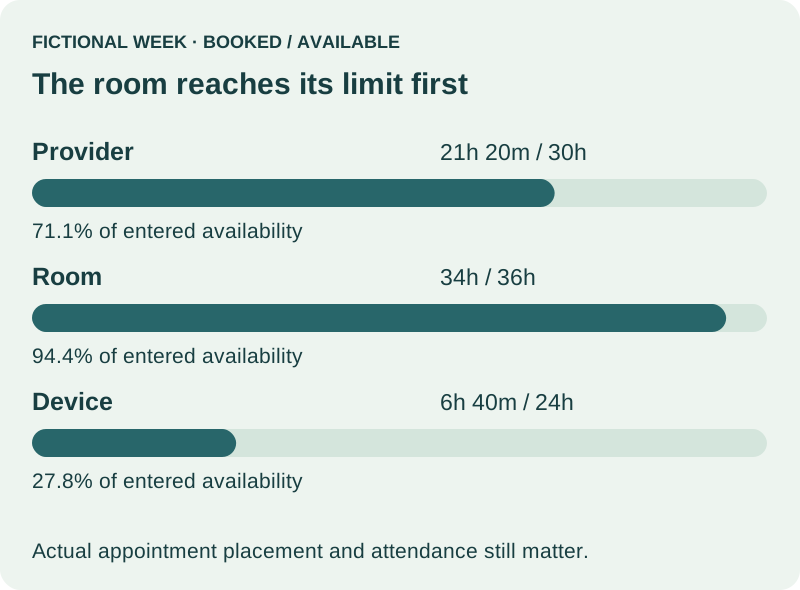
Consider a fictional practice with one shared treatment room and a clinician rostered for 40 hours. After five hours of breaks and five hours of planned non-treatment work, 30 provider hours are available for the scheduled services. The room has 36 usable hours, and the relevant device is available for 24 hours.
The practice wants to book these appointments. Times are deliberately simplified planning inputs, not recommendations for clinical care. The device appointment assumes the clinical lead has approved the stated provider-attendance model; if continuous attendance is needed, the provider figure must increase.
| Service | Weekly bookings | Provider minutes per visit | Room minutes per visit, including turnover | Device minutes per visit |
|---|---|---|---|---|
| Consultation | 12 | 30 | 30 | 0 |
| Injectable appointment | 24 | 30 | 45 | 0 |
| Device appointment | 10 | 20 | 60 | 40 |
| Total | 46 | 21 hours 20 minutes | 34 hours | 6 hours 40 minutes |
At first glance, the clinician has almost nine hours available. The room, however, has only two hours left. Hiring another provider would not by itself create another place to treat patients.
The same week, distributed across five days
| Day | Consultations | Injectable visits | Device visits | Provider time reserved | Room time reserved | Room time available |
|---|---|---|---|---|---|---|
| Monday | 2 | 5 | 2 | 4h 10m | 6h 45m | 7h |
| Tuesday | 3 | 5 | 2 | 4h 40m | 7h 15m | 7h 30m |
| Wednesday | 2 | 4 | 2 | 3h 40m | 6h | 7h |
| Thursday | 3 | 5 | 2 | 4h 40m | 7h 15m | 7h 30m |
| Friday | 2 | 5 | 2 | 4h 10m | 6h 45m | 7h |
| Total | 12 | 24 | 10 | 21h 20m of 30h | 34h of 36h | 36h |
These totals identify the likely constraint; they do not prove every appointment can be placed without conflict. The practice still has to assign actual start times, breaks and qualified staff. A single long opening is not equivalent to several scattered ten-minute gaps.
What would change the conclusion?
If every 60-minute device appointment required the clinician throughout, those ten visits would consume ten provider hours rather than three hours and 20 minutes. Weekly provider demand would rise from 21 hours and 20 minutes to 28 hours, leaving only two available. The same appointment count would then put both provider and room capacity under pressure.
This is why staffing assumptions must be confirmed before calculating how many treatments a device can support. “Hands-free” and “provider-free” are different operating claims. A system with unattended intervals still needs an appropriate monitoring and response plan.
How do cancellations change the picture?
A calendar can be nearly full when booked and considerably less full when the week is complete. Track those two states separately.
In the fictional week, three consultations, two injectable appointments and one device appointment cancel or do not occur. That releases four room hours: 90 + 90 + 60 minutes. The team refills two of them. Completed room use becomes 32 hours, or 88.9% of the 36 usable hours, compared with 94.4% reserved at the start.
| Where the 36 room hours went | Hours |
|---|---|
| Delivered appointments, after refilling some gaps | 32 |
| Initially unsold room time | 2 |
| Canceled room time that stayed unfilled | 2 |
| Total usable room time | 36 |
Neither percentage is a recommended target. The example shows why “we are 94% booked” can overstate the work delivered. It also shows that not every cancellation becomes a permanent lost appointment: some can be refilled, some can be rescheduled, and others produce lost demand or delayed cash.
Record the timing of cancellations. A gap known four days ahead may be easier to fill than one created an hour before treatment. Track the result of reminders and waitlist outreach without assuming that a stricter cancellation policy will solve every scheduling problem.
Build your own weekly capacity example
Enter a representative week using your actual service times. Include required preparation and turnover in room time and all necessary clinical attendance in provider time. The tool compares the hours demanded by your bookings with the hours available.
Your weekly capacity plan
Use the example to understand the calculation, then start with your own figures. All money is in US dollars.
Calculate to see the breakdown.
Keep the figures and the next steps together
Save this editable worksheet, track the five preparation steps and download a copy. Return through your private practice workspace. No email delivery, marketing enrollment or vendor introduction is included.
The result identifies a resource to investigate. It does not authorize overlapping care, shorter cleaning intervals or a staffing arrangement. If several resources approach their limits, test an actual timed schedule with your clinical and operations leads before adding appointments.
Is this a staffing problem, a room problem or a scheduling problem?
Look at where work waits and which requests cannot be fulfilled. The strongest evidence is a repeated pattern across ordinary weeks, not one unusually busy launch or holiday week.
| Pattern | Likely constraint to investigate | A useful first experiment | What would support expansion |
|---|---|---|---|
| Qualified providers are full while appropriate rooms are available | Clinical staffing or avoidable work consuming clinical time | Protect charting time; move suitable administrative tasks; test a limited additional clinic session | Suitable unmet demand continues and can fund qualified staffing |
| Providers have time but suitable rooms are full | Room occupancy or room-specific service mix | Map preparation and turnover; move appropriate non-treatment tasks; test a different mix across existing rooms | Requests remain unserved because no safe, suitable room is available |
| Tuesday has gaps while evenings are full | Demand timing or scheduling rules | Offer relevant waitlist options and a limited schedule change patients can actually use | Additional hours or space match documented patient demand |
| Rooms and clinicians have gaps but inquiries go unanswered | Front-desk capacity or follow-up ownership | Assign inquiries, measure response time and track booking outcomes | Recovered demand fills appointments before equipment or space is added |
| The calendar is full but cash feels tight | Service contribution, package obligations or collections | Reconcile delivered visits, discounts, outstanding packages and costs | Higher capacity would produce additional contribution, not simply more low-margin work |
For a solo provider, a small amount of administrative help can sometimes release more useful clinical time than another machine. For a managed team, handoffs and uneven permissions may be the issue. For plastic-surgery or dermatology practices, aesthetic scheduling should fit around the clinical and procedural commitments that cannot simply be moved.
How do you turn scattered gaps into useful appointments?
First measure the gap against the complete resource requirement. A 20-minute space cannot accommodate a 45-minute visit just because the treatment itself is brief. Look for recurring patterns: consultations split throughout a device-heavy day, rooms occupied by nonclinical discussions that could occur elsewhere, or a service that repeatedly overruns its booking template.
Test a limited change and measure both the benefit and any consequences. You might group suitable appointments, alter a booking template to reflect observed duration, reserve a small number of consultation slots or give the front desk clear rules for offering the waitlist. Preserve patient choice and clinical requirements.
Do not create “efficiency” by removing required disinfection, rushing consent, shortening assessment or expecting staff to work through every break. A schedule that runs only when nothing goes wrong is fragile. Keep appropriate recovery time for the practice’s actual complexity rather than borrowing an unsupported universal utilization target.
The software comparison guide includes a demonstration script for checking whether a system can book the clinician, room and device together and make handoffs visible.
How many extra visits would a new room or employee need?
Use additional contribution, not the full treatment price, to test the expansion. Contribution is collected revenue minus the additional costs of delivering those visits. Include all new fixed commitments introduced by the change, such as wages, payroll costs, rent, equipment, software, training and support.
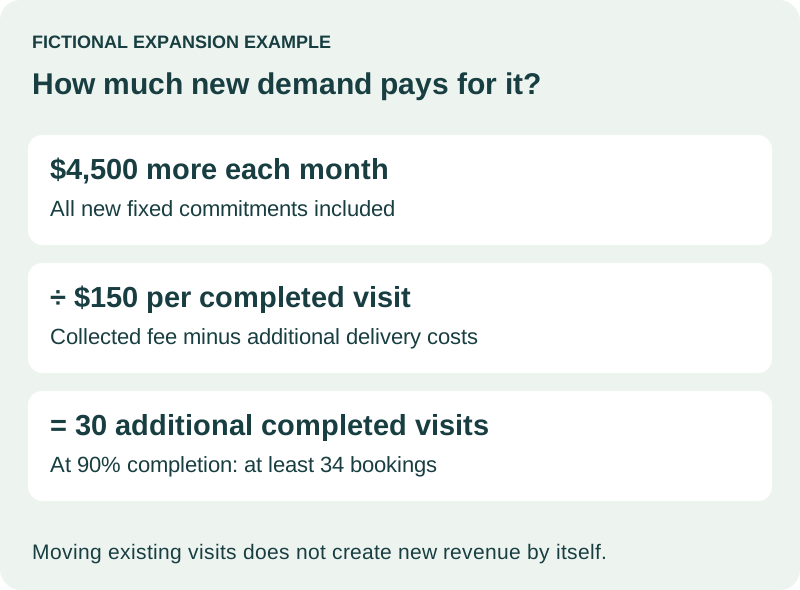
Suppose a fictional expansion costs $4,500 more each month and an additional completed appointment leaves $150 after variable delivery costs. It needs 30 additional completed appointments per month just to cover that defined commitment: $4,500 ÷ $150 = 30.
If 10% of additional bookings do not turn into completed appointments and those gaps are not refilled, you need at least 34 additional bookings: 30 ÷ 0.90 = 33.33, rounded up. Thirty completed visits a month is roughly seven a week on an annualized basis. Use a calendar appropriate to your opening days and time off when building the actual schedule.
Which visits actually count as additional?
Appointments moved from an existing clinician or room do not automatically create new practice revenue. If a new hire takes 20 of the owner’s existing visits, the direct financial benefit depends on what happens to the owner’s released time. It might enable more consultations, improve follow-up or provide a deliberate reduction in owner workload. Those can be valid goals, but they need different financial expectations.
Include ramp-up. A person hired today may need training and time to build a schedule. A room may create rent and financing obligations before it produces revenue. Use the 12-month opening cash-flow example to model those uneven months rather than assuming the mature workload begins immediately.
What should you measure for four weeks before expanding?
Choose a period that represents ordinary demand and record unusual events. Four weeks is a practical starting exercise, not proof that seasonality or longer treatment cycles no longer matter.
| Measure | What to record | What it helps answer |
|---|---|---|
| Requests you could not serve | Requested service and time, reason unavailable, alternative offered and outcome | Is there suitable demand the proposed change would actually serve? |
| Resource use | Reserved and delivered provider, room and device time | Which resource is limiting the work? |
| Appointment changes | Cancellation notice, no-show, refill, reschedule and refund outcomes | How much apparent demand becomes completed work? |
| Staff interruptions | Repeated calls, checkout problems, stock searches and unfinished handoffs | Can a workflow fix release useful time? |
| Treatment obligations | Package visits owed, likely timing and available slots | Is future capacity already promised? |
| Financial contribution | Collected fees, additional delivery costs and new fixed commitments | Would extra volume improve the business sufficiently? |
Use de-identified totals in this planning exercise. The NuWays MD worksheet is not a place to store patient names, medical details or staff-sensitive records.
Review the findings with the people doing the work. Assign one change, an owner, a review date and the result you hope to see. “Reduce unfilled canceled room time from two hours to one in a representative week” is a testable experiment. “Become more efficient” is not enough to guide a team.
When does expansion make sense?
Expansion is more defensible when several conditions line up: suitable demand repeatedly goes unserved, a specific resource is the reason, smaller workflow changes have not resolved it, and the expected additional contribution covers the new commitment with room for slower months.
It may still be reasonable to expand for a strategic goal, such as reducing owner workload or adding a complementary service. State that goal explicitly and budget for it. A capacity calculation should help you make a conscious tradeoff, not turn every empty slot into pressure to sell another treatment.
Save my weekly capacity plan and next experiment
Keep your own figures, preparation progress and open questions in one private practice worksheet.
Open my worksheet and save ↗Frequently asked questions
What utilization percentage should a med spa aim for?
There is no single target established by this guide. Appropriate capacity depends on service complexity, staffing, monitoring, turnover, breaks and demand patterns. Track your own booked and delivered use, delays, quality and finances before adopting a percentage from another business.
Should I hire when I am booked two weeks out?
Look at which services, clinicians and times are booked and what patients do when offered an alternative. A two-week wait for one popular evening slot differs from a consistently full schedule with suitable patients leaving because nothing is available.
Can I count passive treatment time as free provider time?
Only after the clinical lead has defined the required attendance, monitoring and response arrangements. If continuous provider presence is needed, include that time. The worked example shows how changing this assumption can make provider capacity nearly as tight as room capacity.
Does another device increase capacity?
Only if device availability is the actual limit and the practice also has suitable demand, staff and room time. A second console can sit idle beside the first if the bottleneck is a room, a qualified provider or weak booking conversion.
How should prepaid packages appear in the plan?
Track visits still owed and their likely timing separately from new sales. Those appointments will consume future staff, room and supply capacity even though payment may already have been collected. Your schedule and cash-flow model need to include both.
What if I want to work less rather than grow revenue?
That is a valid planning goal. Model the cost of replacing your clinical and administrative hours, how much owner income changes and what responsibilities remain with you. Do not label replacement visits as new revenue simply because a new employee performs them.
How often should the plan be reviewed?
Review it when the service mix, staffing, opening hours or demand changes, and after a defined scheduling experiment. A brief recurring operations review can catch trends before they become a purchase decision. Avoid rebuilding the model from one unusually good or bad day.
Methodology, sources and next steps
The weekly schedule, cancellation example and expansion calculation are original fictional models created to make the arithmetic inspectable. They are not observed patient data, clinical scheduling protocols or industry benchmarks. Inputs and calculations were checked September 22, 2026. The AHRQ workflow toolkit supports the general task-mapping approach.
NuWays MD’s founder contributes approximately seven years of practice-ownership experience. Clinical staffing, supervision and treatment protocols require appropriate professional review. See our editorial and commercial standards, equipment ownership guide and software workflow comparison for the next decisions connected to this plan.