Hair Not Falling Out After Laser? Shedding, Regrowth and When to Follow Up
Still seeing hair after your appointment can be frustrating. Here is why shedding takes time, what stubble and patchy regrowth can mean, and what to do if you are not seeing progress.
Save my consultation questions ↗Still seeing hair? A quick guide to what comes next
Only a few days have passed
Visible stubble can remain while treated hairs work outward. It is usually too early to judge lasting reduction.
Over the following weeks
Shedding may be subtle. Look for changes in how much hair returns and how often you need to shave.
Little change after several visits
Book a progress review before adding more sessions. Hair characteristics, timing and treatment delivery all matter.
Pain, blisters or a suspected burn
Get the skin reaction assessed promptly. Severe or rapidly worsening symptoms need urgent care. More on skin concerns.
When Does Hair Fall Out After Laser Hair Removal?
Treated hair usually sheds gradually over the following days and weeks, rather than falling out during the appointment. A commonly described window is around two to three weeks. You may notice loose hairs while washing, or simply find that an area becomes less stubbly. Some shedding is easy to miss, especially if you shave.
If it has only been a few days, visible hair is usually too early a sign to judge the result. If several weeks have passed with no noticeable change, a progress review is reasonable. Several treatments with little change deserve a fuller reassessment of whether the treatment suits your hair and what needs to change.
The two-to-three-week estimate comes from NHS patient guidance; Mayo Clinic describes a broader days-to-weeks period. Neither is a deadline that every hair must meet. NHS hair-removal guidance. Mayo Clinic overview.
Why hair stays visible after treatment
Laser hair removal uses light absorbed by the pigment in hair. That light becomes heat, which damages the structures that produce hair and can reduce future growth. The hair shaft already sitting in the skin still has to work its way out. That is why the treatment and the visible shedding happen at different times. How laser hair removal works.
Think of the visible hair as the part you can inspect, and the follicle beneath it as the part the treatment is trying to affect. A shaft can remain visible even after treatment has affected its follicle. As that retained shaft moves toward the surface, it can look as though it is continuing to grow.
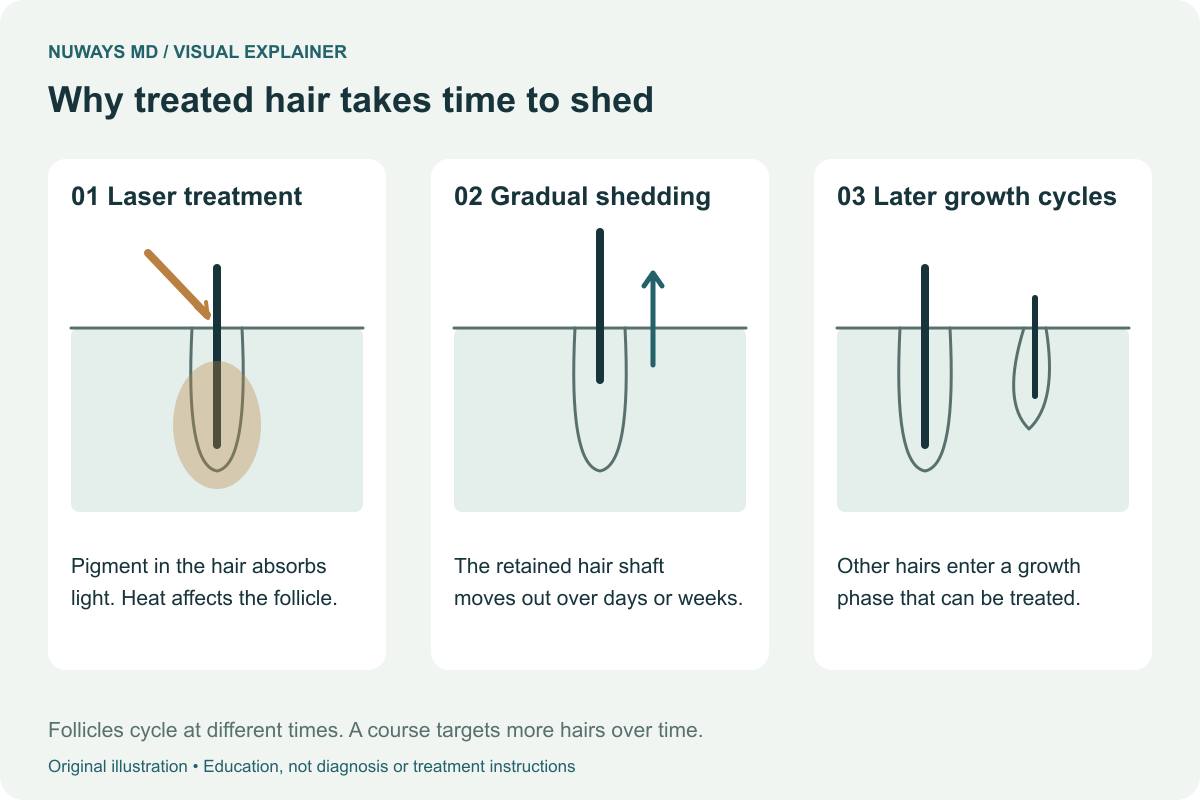
Hair follicles cycle through growth and resting phases. Laser is most effective on hairs in the active growth phase, called anagen. Because neighboring hairs are not all in that phase together, one session cannot address the whole future growth pattern. Later appointments target more hairs as they enter a responsive phase. NHS explanation of hair growth cycles.
What you may notice over the next few weeks
| When | What you may see | What to do |
|---|---|---|
| First few days | Stubble can still be present. Mild temporary redness or swelling can accompany treatment. | Follow your aftercare instructions and let irritated skin settle. It is too early to assess lasting reduction. |
| Around the next two to three weeks | Treated hairs may loosen and shed. The area may look uneven as some hairs remain visible. | Allow hairs to release naturally. Shaving can make this change less obvious. |
| Before a later appointment | New visible growth may appear. Less hair, finer hair or a longer interval before shaving can be useful changes to describe. | Tell the clinician what changed and what did not, including the date you last shaved. |
| After repeated appointments | The overall pattern should be reviewed against the goal agreed at consultation. | If the amount or rate of growth seems unchanged, request a review before committing to more sessions. |
This is a way to organize observations, not a treatment schedule. The area being treated and your response affect when the next session makes sense. For a fuller explanation of sessions and maintenance, see our laser hair removal guide.
Shedding vs. Regrowth: Why Hair Can Still Look Visible
Stubble that feels like it is growing back
Short hairs can feel prickly as they reach the surface. In the early shedding period, some of those hairs may be retained shafts moving outward. Others may still be growing. You cannot reliably sort every hair into one group by looking at it or tugging on it.
Patchy or uneven change
An area can become less hairy in some places before others. Growth cycles are one explanation. Treatment coverage and how individual hairs respond are also things the clinic can review. If a sharply defined strip repeatedly seems unchanged, point out its location rather than assuming that patchiness is automatically expected.
Hair returning later
Laser aims for lasting reduction in unwanted hair. Regrowth and maintenance treatments can still be part of the experience. Hair that returns may be finer or less dense. Compare the pattern over time instead of expecting every appointment to leave permanently smooth skin. AAD results and maintenance guidance.
Four everyday examples
These are fictional examples to make the timeline easier to understand, not diagnoses of a particular person’s result.
“It is day five and my legs still feel prickly.”
At this stage, retained hairs may still be visible. Follow your care instructions and observe the area through the expected shedding period. If the skin itself is painful or blistered, deal with that separately and promptly.
“Two weeks later, some spots are smoother and others are not.”
Write down which areas changed. A patchy pattern can occur during a series, but a repeatedly unchanged strip is worth showing the treating clinician.
“I shaved and never saw hairs fall into the shower.”
You may have cut off the part that would make shedding visible. Focus on whether less hair returns or shaving is needed less often, rather than trying to collect shed hairs.
“After several visits, I am shaving just as often.”
Bring that observation to a progress review. Discuss the original expectations, the hair and skin characteristics, treatment records and whether a different approach would be more useful.
Can You Shave or Exfoliate After Laser Hair Removal?
Shaving cuts the hair at the skin surface. Waxing, tweezing, threading and epilating pull it from the follicle. During a laser series, follow instructions to avoid removing hairs from the root. Do not pull on hairs to test whether the laser worked. NHS: care between sessions.
Wait until your clinician says it is appropriate to shave again. Skin should not be scraped while it is sore or irritated. Clinic instructions differ: Leeds Teaching Hospitals advises a five-day pause, which illustrates why the instructions for your own treatment matter.
Can I pull out a hair that slides out easily?
A loosened hair may come away during normal gentle washing. That can happen as part of shedding. Leave it to release naturally rather than testing hairs with tweezers. How much a hair resists, or whether removal hurts, does not reliably tell you whether its follicle can grow another hair.
Do I need to exfoliate to make the hair shed?
No. Retained hairs can shed without an exfoliation routine. While the area is red, tender or irritated, wash gently and avoid scrubs, exfoliating gloves, acids and picking. Even after it feels better, restart exfoliation according to your aftercare rather than a universal day 7 or day 10 rule. NHS advice to let hairs shed naturally. Leeds advice to avoid rubbing and scratching.
Why Is My Hair Not Shedding After Laser? Factors to Review
| Possible factor | Why it matters | Useful follow-up |
|---|---|---|
| Hair color and thickness | Laser relies on pigment. Pale, gray, white and some red hairs respond poorly. | Were the remaining hairs likely to respond in the first place? |
| New or hormone-related growth | Laser treats hair growth in the area, but does not correct an underlying hormonal cause. | Does new or changing growth need medical assessment as well as hair removal? |
| Timing and progress through the series | Hair cycles affect which hairs can respond at each appointment. | How is the schedule being chosen for this area and my response? |
| Treatment delivery | Device choice, coverage and energy delivery can affect response. Fluence means the laser energy delivered per unit area; it is one part of the treatment approach. | Can we review the treatment record and explain the next step? |
A treatment that delivers insufficient energy to the intended target may produce limited reduction. But a setting number alone cannot establish why a session disappointed: device, pulse duration, cooling, skin and hair characteristics work together. A clinician should review the record rather than simply turn the energy up. Professional guidance requires settings to stay within an appropriate treatment protocol. BMLA treatment guidance.
Hair-color and hormonal limits are described by Mayo Clinic. Do not adjust your own expectations to an unlimited number of sessions. Ask what improvement would justify continuing and when the clinician would recommend changing course. For light hairs that respond poorly to laser, our treatment guide explains electrolysis and other options.
Can Laser Hair Removal Cause More Hair Growth?
Occasionally, increased hair growth can occur after laser or IPL treatment. This is called paradoxical hypertrichosis. It means an increase in growth, rather than the short-term appearance of stubble during shedding.
A systematic review found a stronger association with treatment on the face or neck; cases elsewhere were much less common. The mechanism and risk factors are not fully understood. The review did not have enough data to establish associations with sex or skin type. Systematic review of paradoxical hypertrichosis.
If growth seems persistently denser or extends beyond the original pattern, arrange an assessment before further sessions. Bring the treatment dates and any comparable photographs. That gives the clinician something concrete to review without trying to diagnose the cause from a few hairs in the mirror.
When the skin needs attention
Contact the treating clinic promptly for blistering, a suspected burn, worsening pain or an unexpected change in skin color. Infection and scarring are possible complications. Severe or rapidly worsening symptoms need urgent medical assessment. Waiting for hair to shed is not an appropriate way to assess a skin injury. AAD laser risks.
A useful message is: “I had treatment on [date] in [area]. Since [time], I have noticed [change], and it is improving/staying the same/worsening.” Ask how to share any photographs securely with the treating practice. NuWays MD does not assess injuries or collect intimate photographs.
What if the next suggestion is another package?
First get an explanation of your progress. Then compare the remaining visits, total cost, review point and cancellation terms. A lower price per session can be useful if continuing is appropriate, but it cannot tell you whether your hair is responding.
Understand laser series costs and package terms ↗Keep your follow-up questions in one place.
Save a focused list about shedding, shaving, progress and what to do if the next few appointments bring little improvement. Mark questions answered as you discuss them.
Save my laser follow-up questions ↗More questions about shedding
Does every treated hair need to fall out?
Do not expect a single, complete “fallout.” Visible shedding and long-term reduction are related parts of the process, but counting shed hairs is not a reliable way to grade a session.
Can shaving make hair thicker?
A freshly cut shaft can feel blunt and prickly. That sensation alone does not establish increased growth. A persistent increase deserves assessment for possible paradoxical hypertrichosis or another cause, as explained above.
Does no pain mean the treatment did not work?
Comfort and hair response are different observations. Cooling and treatment technique affect sensation. Request a progress review rather than asking for more pain or stronger settings.
Should I cancel my next session if I have not shed?
Contact the clinic before the appointment and explain the timing and changes you have seen. The decision should account for your skin condition, treatment history and expected response.
Sources and editorial notes
BMLA treatment guidance: professional treatment parameters and response assessment.
Paradoxical hypertrichosis systematic review: increased growth, location associations and limitations in risk-factor evidence.
Sources checked September 16, 2026. Clinical review is pending. NuWays MD is an education and research publication, not a medical provider. This guide is not medical advice or an assessment of your skin.
- Mayo Clinic: laser hair removal: shedding, pigment-related response and hormonal limitations.
- Cleveland Clinic: laser hair removal: how light energy affects hair follicles.
- Sandwell and West Birmingham NHS: laser hair removal: retained hairs, growth cycles and care between sessions.
- Leeds Teaching Hospitals: laser hair reduction: aftercare and potential increased hair growth.
- AAD: laser hair removal FAQs: maintenance, reactions and complications.
Diagrams and fictional examples are original educational explanations. How we research content and disclose commercial relationships. Saving questions does not authorize an appointment request or the sharing of your information with a practice.