Uneven Skin Texture or Acne Scars? Understanding the Difference and Your Options
Bumps, visible pores, lingering marks and small dents can all make skin look uneven. Understanding what causes each change helps explain why different treatments work, and what improvement you can realistically expect.
Save my consultation questions ↗Acne marks, roughness or scars? Start here.
Flat red or brown marks
A change in color after inflammation. These marks can fade with time and appropriate treatment. Marks vs. scars.
Roughness or visible pores
Oil, clogging, irritation and skin firmness can affect how the surface looks. Care depends on the cause. What skincare can improve.
Dents, pits or dips
A change in the skin’s structure. More noticeable depressions often benefit from professional scar treatment. How the options work.
Why does skin look uneven after acne?
Acne can leave both a change in color and a change in the skin’s shape. A flat red or brown mark can remain after a spot has healed. A depressed scar leaves a dip; a raised scar adds a bump. You can have several of these changes at once, along with active breakouts or visible pores.
That explains a common frustration: a product may fade a dark mark while the dent beneath it remains. The color has improved, but the skin’s structure still needs a different kind of attention. Likewise, softer-looking scars do not necessarily mean every dark mark will disappear.
Flat post-acne marks often fade over time, while structural scars can be lasting. Treatment can make scars less noticeable, but completely smooth, poreless skin is not a realistic standard. AAD explanation of acne marks and scars.
Acne Marks vs. Acne Scars: How to Tell the Difference
Bumps and ongoing breakouts
Raised pimples, clogged pores or deeper tender spots can create unevenness while acne is active. Treating the breakouts helps reduce new inflammation and the chance of more lasting marks.
Flat red or brown marks
These change how skin looks even when the surface feels smooth. After inflammation, pigment or persistent redness can remain. Fading can take months or longer.
Dents or depressions
These are changes in contour. Shadows can make them more obvious from one angle than another. The depth, shape and attachment of a scar affect the treatment options.
Visible pores or roughness
Pores are normal openings. Oil, clogging and skin firmness can affect their appearance. Dryness or irritation can also make skin feel less smooth; an examination can help clarify the cause.
You do not need to diagnose yourself before getting help. Plain descriptions such as “flat but darker,” “a dip that catches the light,” or “small bumps that keep returning” are useful starting points. DermNet on post-acne changes. AAD on visible pores.
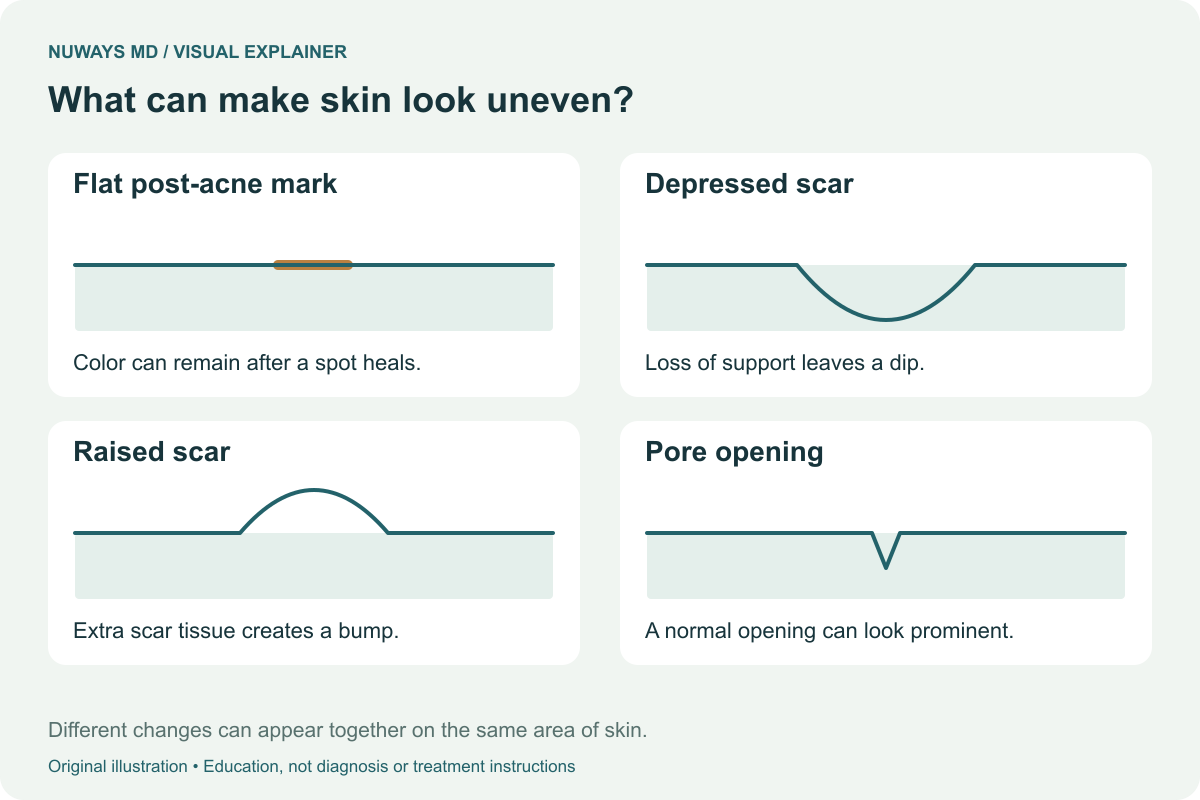
How acne creates a scar
Inflammation from acne can damage collagen in the deeper skin. Collagen acts as part of the skin’s supporting framework. If healing leaves too little support, an indentation can remain. If the body produces excessive scar tissue, a raised scar can form. Picking and squeezing can add injury and increase the chance of scarring. DermNet explanation of scar formation.
This is why repeatedly exfoliating a dent is unlikely to solve the whole problem. Its shape involves tissue beneath the surface. A clinician may need to stimulate new tissue, release an attachment pulling the skin downward, add volume or treat a small deep scar directly.
The main types of depressed acne scars
| Name you may hear | Plain-language description | Why the shape matters |
|---|---|---|
| Ice-pick | A narrow, deep pit. | A small opening may extend deeper than it looks. Broad surface treatment may not fully address it. |
| Boxcar | A round or oval depression with more defined edges. | Depth and edges help determine whether resurfacing or a targeted procedure is considered. |
| Rolling | A wider dip with sloping edges that can make skin look wavy. | Some scars are attached to tissue underneath; releasing that attachment may be part of treatment. |
Most people do not fit neatly into one type. A cheek can contain several scar shapes as well as discoloration. Raised scars need a different assessment from these depressed scars. AAD scar shapes. Review of procedures matched to acne-scar type.
Can Skincare or Retinoids Fix Indented Acne Scars?
Skincare can make mild scarring less noticeable and help with acne, dark marks and roughness. It usually cannot make deeper pits or tethered scars disappear. The AAD includes retinoids and salicylic acid among options for mild scarring. A deeper indentation may need a procedure that addresses the tissue underneath. AAD treatment guidance.
Retinoids are vitamin A-related treatments that help keep pores from clogging and are used for acne and some skin changes. Their usefulness does not mean every dent will fill in. A good routine can still improve the surrounding skin and help prevent new breakouts while you consider scar treatment.
- Active acne: treatments such as retinoids help prevent clogged pores; other acne medicines target inflammation or bacteria. The right combination depends on the acne and your history.
- Visible pores: gentle cleansing, appropriate acne care and sun protection can reduce factors that make pores more noticeable. Pores cannot be permanently closed.
- Post-acne dark marks: treating new acne and protecting skin from the sun help avoid adding to the problem while existing marks are addressed.
- Established dents: topical care may improve the overall appearance, but more substantial structural scars often need procedures for a meaningful change.
Discuss a routine appropriate for your skin, medicines and pregnancy status if relevant. More acids or more frequent exfoliation can add irritation. You do not need to build a complicated routine before seeking a diagnosis. AAD acne treatment. AAD pore care. AAD acne and dark marks in skin of color.
How the main treatment options work
Microneedling: stimulating repair with tiny punctures
A device makes small needle punctures that start a healing response. New collagen can help soften the appearance of selected depressed scars. Improvement is gradual, and a series may be considered. It does not mechanically release every tethered scar. Cleveland Clinic microneedling overview.
RF microneedling: adding heat beneath the surface
Radiofrequency microneedling combines needles with energy that heats tissue. Morpheus8 is one brand. The additional heating changes the treatment and its risks, including the serious complications described in the FDA’s RF warning. Whether it offers enough benefit over conventional needling depends on the individual concern.
Understand Morpheus8, recovery and risks ↗Compare conventional and RF microneedling ↗Laser resurfacing: using light energy to remodel skin
Resurfacing lasers affect skin to stimulate healing and collagen remodeling. Some remove tiny areas of surface tissue, while others heat tissue without removing the surface in the same way. Recovery, pigment risk and the degree of improvement differ by laser and treatment. A laser can make scars less noticeable, but does not erase them. AAD laser treatment for scars.
Chemical peels: a controlled treatment of skin layers
A clinician applies a solution to produce a controlled change in the skin. Different peel depths have different aims and recovery requirements. Selected peels may help discoloration or some scarring. A mild exfoliating facial and a deeper medical peel should not be expected to produce the same effect. AAD scar-treatment options.
Subcision: releasing a scar that pulls downward
Under local anesthesia, a clinician can release fibrous attachments beneath selected depressed scars. This allows the depressed area to lift. It may be combined with another procedure because releasing a tether and improving surface texture address different features. Clinical review of atrophic acne-scar procedures.
Fillers and small scar procedures
Fillers add volume beneath selected depressions. Many are temporary and bring their own risks and maintenance costs. Some deep or sharply defined scars may instead be treated individually by removing or lifting a small area of scar tissue. These are clinician-performed procedures, not home techniques. AAD scar treatment.
Which option matches which concern?
| Main concern | A treatment discussion may start with | Why |
|---|---|---|
| Active acne with new bumps | An acne treatment plan. | Reducing new inflammation helps prevent more marks and scars. |
| Flat discoloration after acne | Sun protection, topical care and selected pigment or redness treatments. | The main target is color. An additional depression needs its own assessment. |
| Widespread shallow texture or selected scars | Microneedling, resurfacing or other individualized procedures. | A broader skin-remodeling approach may suit some patterns. |
| A scar pulled down by underlying tissue | A targeted scar assessment, including whether release is useful. | Surface treatment alone may leave the attachment unaddressed. |
| A few deep, narrow scars | A clinician experienced in focal scar techniques. | Treating the whole face more intensely may not be the most useful answer to a few deep pits. |
| Raised scars | A separate raised-scar treatment plan. | Adding volume or treating it as a depression would miss the problem. |
The best plan may combine methods or use them in stages. It should explain what each step is expected to contribute. The AAD describes individualized scar treatment based on scar type, skin tone and other factors.
What would this mean in everyday life?
These fictional examples show why two people searching for “acne scar treatment” can need different answers.
“My skin feels smooth, but the old spots still look dark.”
The first goal may be fading discoloration and preventing new marks. An expensive scar-remodeling procedure could leave that main concern insufficiently addressed.
“The color has faded, but side lighting shows small dents.”
The remaining concern is structural. A clinician can assess the shapes and explain which areas may respond to broad resurfacing and which need targeted treatment.
“I have dents and I am still getting painful breakouts.”
Controlling the acne usually comes first. Otherwise, new scars may develop while you are investing in older ones. Scar treatment can be planned once the acne is controlled.
“I mainly notice pores in close-up phone photos.”
Start with a realistic view of normal skin and any oil or clogging concerns. Magnified, harshly lit photos should not be the standard your skin has to meet.
Recovery, skin tone and realistic results
A procedure’s visible recovery and its final improvement happen on different schedules. Redness may settle before collagen-related change is complete. A consultation should explain when the skin will be suitable for work, makeup and your usual activities, and when results will be assessed.
Skin that develops dark marks after inflammation needs particular attention to pigment risk. Prior reactions, recent tanning, current acne and medicines can change treatment decisions. Tell the clinician what you use and what has caused problems before. AAD scar-laser consultation guidance.
Use before-and-after photographs carefully. Changes in light direction can hide or deepen the shadows around scars. Look for consistent lighting, angle and time after treatment, and ask whether several procedures contributed to the result. Realistic success may be softer-looking scars, not their complete disappearance.
What should a treatment plan cost?
The price depends on whether you need treatment across an area, individual scar work, or a combination. Compare the same concern and scope. A single session price cannot show the cost of several visits, recovery products or later maintenance.
Ask for the number of visits, total expected cost, review point and any optional additions in writing. If a package is offered, clarify expiry, cancellation and unused-visit terms. You should have time to consider the plan after the consultation.
Explore published microneedling and RF price examples ↗Compare skin treatments by purpose ↗Questions people often ask
Will acne scars disappear on their own?
Flat marks can fade with time. Depressed and raised scars are structural changes and may persist. An examination can clarify what you are seeing and whether waiting, skincare or a procedure makes sense.
Can one treatment fix pores, marks and scars?
Some procedures can help more than one concern, but improvement may be uneven. A useful plan names the main goal and explains what may remain afterward.
Is a stronger treatment always better?
No. The right treatment depends on what needs changing and what risk and recovery are appropriate. More heat, deeper peeling or more sessions does not automatically match the problem.
Should I use a home needling tool or strong peel?
Do not try to reproduce clinical scar procedures at home. Needling and chemical injury can cause infection, pigment changes or new scars. Ask for a safe home-care routine and a professional assessment if procedures interest you.
Make your first skin consultation easier.
Save questions about your marks, scars, pores or breakouts. Keep track of the treatment options, realistic improvement, recovery and costs as you learn.
Save my skin texture questions ↗Sources and editorial notes
Sources checked September 16, 2026. Clinical review is pending. NuWays MD is an education and research publication, not a medical provider. This guide is not medical advice or an assessment of your skin.
- AAD acne-scar signs: marks, structural scars and scar shapes.
- DermNet acne scarring: collagen changes, scar formation and post-acne discoloration.
- AAD visible pores: pore appearance and care.
- AAD acne treatment: approaches to active acne.
- AAD acne in skin of color: inflammation and dark marks.
- Cleveland Clinic microneedling: needling and repair.
- AAD scar treatment: clinical options and treatment sequence.
- AAD laser treatment for scars: laser expectations, preparation and risk.
- Clinical review of atrophic acne scars: targeted procedures including subcision; older review used for mechanism, not current device ranking.
- Scar-type treatment review: matching procedures to scar patterns.
- FDA RF microneedling safety communication: risk context for RF treatments.
Diagrams and fictional examples are original educational explanations. How we research content and disclose commercial relationships. Saving questions does not authorize an appointment request or the sharing of your information with a practice.